

Astronomy Object of the Month: 2025, December
< previous Archive
Second generation black holes observed by LIGO, Virgo and KAGRA
A pair of very special black hole mergers, detected just one month apart in late 2024, is improving how scientists understand the nature and evolution of the most violent deep-space collisions in our universe. Some features of these mergers point toward the possibility of “second-generation” black holes, i.e. black holes that are the result of earlier coalescences, probably formed in very dense and crowded cosmic environments, like star clusters, where black holes are more likely to run into each other and merge again and again.
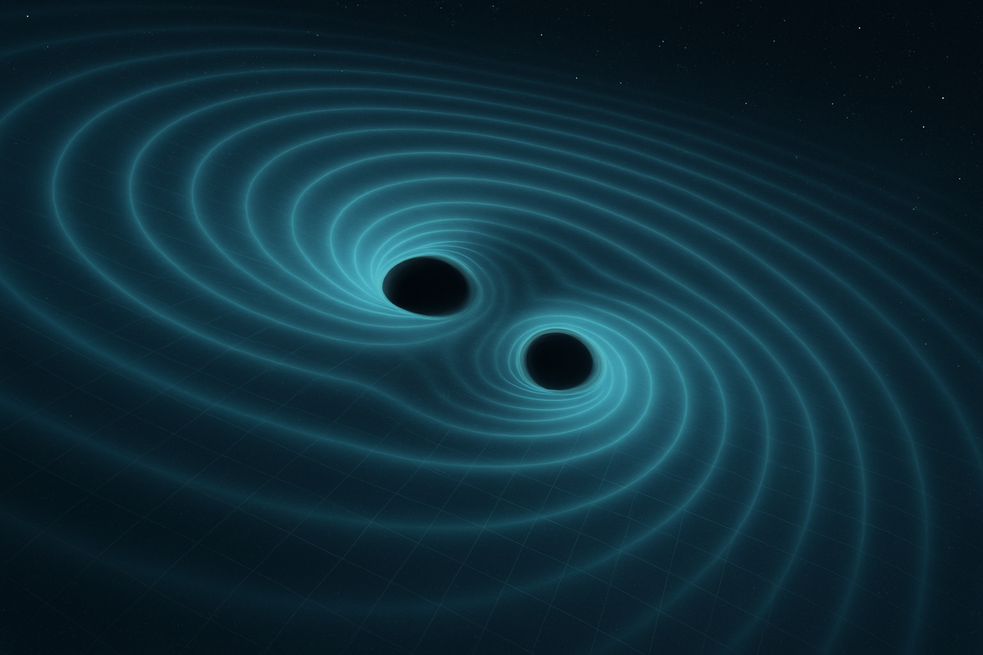
Illustrated: Visualization – merging (fusion) of black holes of different masses (ChatGPT/DALL·E, OpenAI).
In a new paper published recently in The Astrophysical Journal Letters, the international LIGO-Virgo-KAGRA Collaboration reports on the detection of two gravitational wave events in October and November of last year with unusual black hole spins. An observation that adds an important new piece to our understanding of the most elusive phenomena in the universe.
Gravitational waves are 'ripples' in space-time that result from cataclysmic events in deep space, with the strongest waves produced by the collision of black holes. Using sophisticated algorithmic techniques and mathematical models, researchers are able to reconstruct many physical features of the detected black holes from the analysis of gravitational signals, such as their masses and the distance of the event from Earth, and even the speed and direction of their rotation around their axis, called spin.
The first merger detected on Oct. 11, 2024 (GW241011), occurred roughly 700 million light years away and resulted from the collision of two black holes weighing in at around 17 and 7 times the mass of our Sun. The larger of the two black holes in GW241011 was measured to be one of the fastest rotating black holes observed to date. Almost one month later, GW241110 was detected on Nov. 10, coming from around 2.4 billion light years away and involving the merger of black holes roughly 16 and 8 times the mass of the Sun. While most observed black holes spin in the same direction as their orbit, the primary black hole of GW241110 was noted to be spinning in a direction opposite its orbit – a first of its kind.
Both detections, interestingly, point toward the possibility of “second-generation” black holes. GW241011 and GW241110 are among the most novel events among the several hundred that the LIGO-Virgo-KAGRA network has observed. And with both events having one black hole which is both significantly more massive than the other and rapidly spinning, they provide tantalizing evidence that these black holes were formed from previous black hole mergers. Scientists point to certain clues, including the size differential between the black holes in each merger – the larger was nearly double the size of the smaller – and the spin orientations of the larger of the black holes in each event. A natural explanation for these peculiarities is that the black holes are the result of earlier coalescences. This process, called a hierarchical merger, suggests that these systems formed in dense environments, in regions like star clusters, where black holes are more likely to run into each other and merge again and again.

Illustration 2: Event GW241011 – infographic (The Authors).

Illustration 3: Event GW241110 – infographic (The Authors).
Rapidly rotating black holes like those observed in this study have yet another application – in particle physics. Scientists can use them to test whether certain hypothesized light-weight elementary particles exist and how massive they are. These particles, called ultralight bosons, are predicted by some theories that go beyond the Standard Model of particle physics, which describes and classifies all known elementary particles. If ultralight bosons exist, they can extract rotational energy from black holes. How much energy is extracted and how much the rotation of the black holes slows down over time depends on the mass of these particles, which is still unknown. The observation that the massive black hole in the binary system that emitted GW241011 continues to rotate rapidly even millions or billions of years after it formed rules out a wide range of ultralight boson masses.
Original publication: LIGO-Virgo-KAGRA Consortium, GW241011 and GW241110: Exploring Binary Formation and Fundamental Physics with Asymmetric, High-Spin Black Hole Coalescences, The Astrophysical Journal Letters, 993, L21 (2025).
The research described is part of the research topics conducted at the Department of High Energy Astrophysics of the Astronomical Observatory of the Jagiellonian University in Kraków. The following scientists from OAUJ are participating in international gravitational wave research: Prof. M. Ostrowski, Eng. J. Kubisz, and Prof. Ł. Stawarz.
|
Łukasz Stawarz Astronomical Observatory Jagiellonian University L.Stawarz [at] oa.uj.edu.pl |
