

Astronomy Object of the Month: 2026, November
< previous Archive next >
The KL Dra cataclysmic system
Systems known as AM CVns are a rare subtype of binary stars. In general, a binary system consists of two gravitationally bound stars orbiting a common center
of mass. Depending on the evolutionary stage of the stars and their mutual separation, matter may begin to flow from one star onto another along trajectories
of decreasing radii, forming an accretion disk around the gaining star.
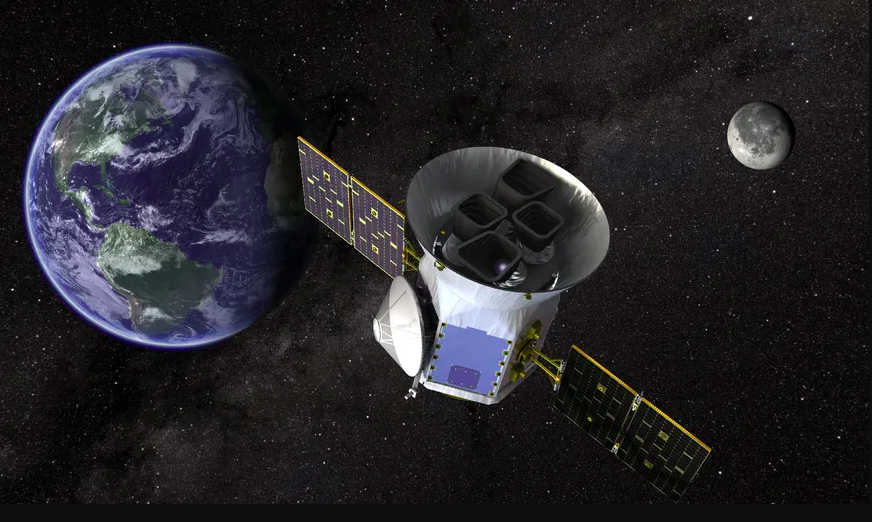
Illustration 1: The TESS satellite in orbit – visualisation (NASA).
In AM CVn binaries, the two stars orbit each other with periods ranging from 5 to about 70 minutes. The accreting star is a white dwarf, and the matter falling onto it is dominated by helium with a small addition of metals. There are no traces of hydrogen, however. The type of the donor star is still a matter of investigation. To date, it is known to be a low-mass star at its last or a very late stage of evolution, meaning it is either a helium white dwarf or an evolved helium star.
Studying AM CVn systems may contribute to a better understanding of the evolution of binary stars, the physics of accretion disks, and the origin of Type Ia supernovae, among other topics. Because of their short orbital periods, they are also objects that emit gravitational radiation at frequencies detectable by the future space-based gravitational wave detector, LISA.
KL Dra is an AM CVn binary with an orbital period of 25 minutes. Observations conducted with the TESS (Transiting Exoplanet Survey Satellite) telescope, operating in orbit since 2018, yielded an unprecedentedly detailed light curve of this system. Complementary data from surveys such as ZTF (Zwicky Transient Facility), ASAS-SN (All-Sky Automated Survey for Supernovae), and ATLAS (Asteroid Terrestrial-impact Last Alert System) enabled us to follow the changes in KL Dra's brightness on timescales ranging from days to months, or even years.
The light curve of this system is characterized by repeating cycles. Each of them starts with an outburst (precursor) which transitions into a so-called superoutburst (brighter and longer than the others). Following the superoutburst, the brightness of the system does not drop to its minimum level (quiescence), but instead rises in a series of low-amplitude rebrightenings, leading to a state of constant brightness lasting several days. After that phase, the system falls into quiescence, during which 3 to 4 normal outbursts of increasing amplitude appear, each lasting about 1 day. The recurrence time of the cycles is about 60 days on average.

Illustration 2: The light curve plotted for the KL Dra system (The Authors).
A total of 49 such cycles were identified in the available data spanning the last 11 years. This is the first analysis for an AM CVn system that is so comprehensive and covers such an extended period of time.
The study of KL Dra's brightness variations and the correlations between different types of these variations is a source of information about instability in the accretion disk surrounding the white dwarf in this system, as it is this instability that causes the characteristic variability of the light curve. A comparison between synthetic light curves obtained from numerical simulations of instabilities in helium accretion disks and the observations of KL Dra may provide clues regarding the mechanisms responsible for the shape of the KL Dra light curve. This, in turn, may help us better understand accretion disk physics in general.
Original publication: Salazar Manzano, L., Rivera Sandoval, L., Hameury, J.-M., Heinke, C. O., Kotko, I., Maccarone, T. J., Pichardo Marcano, M., KL Dra as a benchmark laboratory for accretion-disk physics: Constraints from TESS and ground-based surveys, 2026PASA, 43, 70S, 2026.
The research was conducted at the Department of High Energy Astrophysics of the Astronomical Observatory, Jagiellonian University in Kraków.
|
Iwona Kotko Astronomical Observatory Jagiellonian University I.Kotko [at] oa.uj.edu.pl |
